Imagine Sarah, a lovely woman in her late sixties, bringing in her grandmother's engagement ring. It’s a beautiful piece, a solitaire diamond that catches the light wonderfully, but Sarah's been told by several jewelers that its value is much lower than she expected. She’s confused, and frankly, a little disheartened. The discrepancy, more often than not, boils down to something invisible to the untrained eye: diamond inclusions. These natural birthmarks within a diamond are the unsung heroes (and sometimes villains) of its value, and understanding them is absolutely crucial for anyone seeking an accurate appraisal.
As a personal property appraiser with a decade focused on jewelry, I’ve seen firsthand how critical a thorough understanding of inclusions is. They aren’t just flaws; they’re unique identifiers, much like fingerprints. While a completely inclusion-free diamond, a "flawless" stone, is exceptionally rare and commands a premium, most diamonds have them. The key is what kind of inclusions, how many, and where they are located. For an appraisal, this means moving beyond just admiring the sparkle.
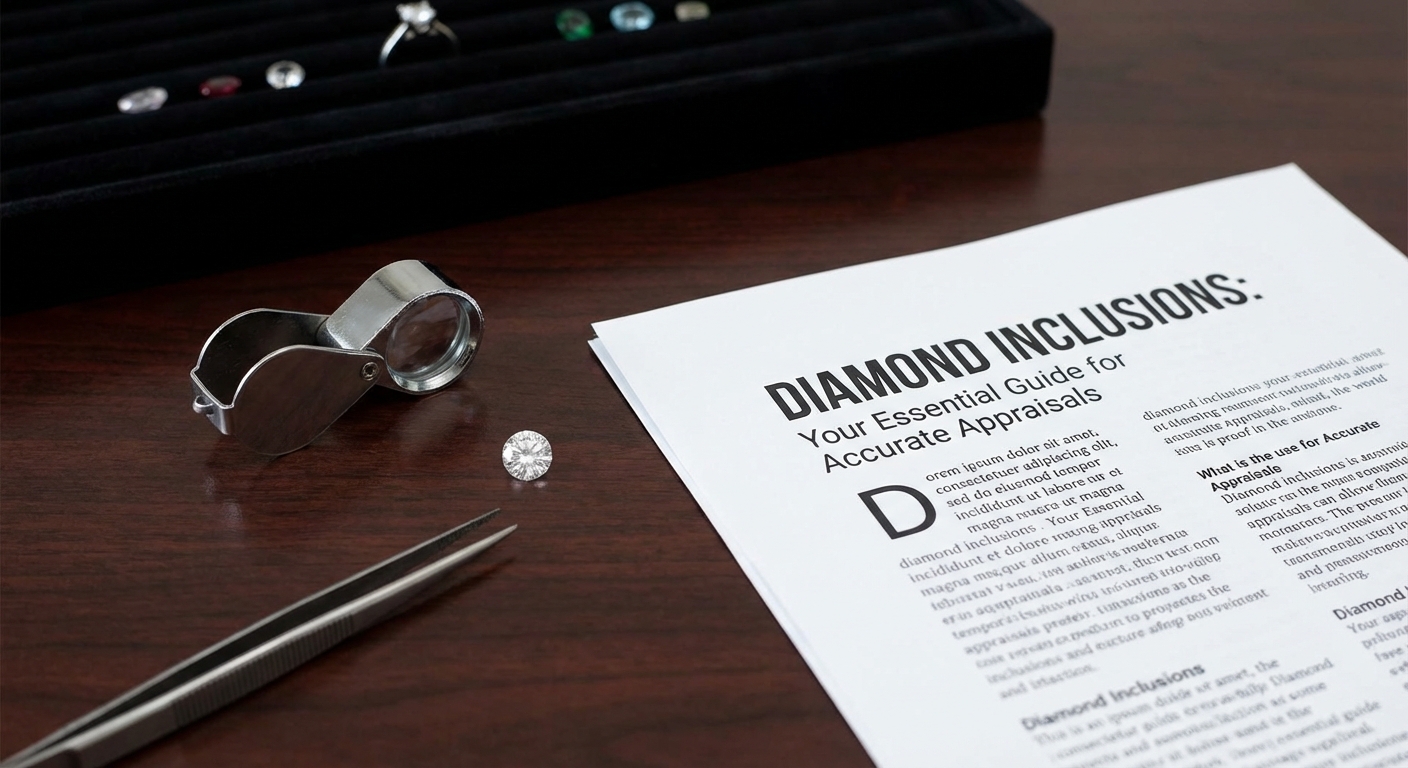
One of the most important strategies I employ is meticulous magnification. Using a jeweler's loupe, typically 10x magnification, is the starting point. I'm looking for the type of inclusion. Is it a feather, a crystal, a cloud, or a pinpoint? Each has a different impact on clarity and, consequently, value. For instance, a large feather inclusion near the girdle might be easily chipped, significantly reducing its durability and price. Conversely, tiny pinpoints clustered together, forming a "cloud," can make the diamond appear hazy, impacting its brilliance.
Secondly, I meticulously map the inclusions. This isn't just about noting their presence; it's about understanding their placement relative to the diamond's facets. An inclusion positioned directly under the table facet, the largest, most visible facet, will have a far greater visual impact than one hidden deep within the pavilion. Think of it like this: a blemish on your forehead is more noticeable than one on your back. This mapping is vital for grading and for explaining the value to clients like Sarah.
A helpful framework to keep in mind is the clarity grading scale, established by organizations like the GIA. This scale, ranging from Flawless (FL) to Included (I3), provides a standardized way to categorize diamonds based on the size, number, position, and visibility of inclusions. While I'm not a GIA-certified gemologist, understanding this scale allows me to communicate effectively with other professionals and to accurately assess a diamond's place within that established hierarchy.
In practice, I recently appraised a beautiful marquise-cut diamond for a gentleman named Arthur. He was convinced it was worth a fortune. Under magnification, I discovered several small, white needle-like inclusions running parallel to each other within the stone. While not numerous, their orientation meant they were quite visible, especially when viewed from the top. This placed the diamond squarely in the "Included" category, significantly impacting its clarity grade and, therefore, its appraisal value. Arthur was initially disappointed, but by explaining the inclusions and showing him exactly where they were with the loupe, he understood the reasoning behind my valuation.
Ultimately, accurate diamond appraisals hinge on a detailed, objective assessment of clarity. It’s not just about the fire and brilliance, but about what lies beneath the surface. So, if you’re looking to have a diamond appraised, whether it’s an heirloom or a recent purchase, be sure your appraiser is taking the time to thoroughly examine those internal characteristics. Don’t hesitate to ask them to show you the inclusions under magnification – it’s your right to understand what contributes to your diamond’s unique value.