I remember a client, Sarah, who came to me with a sapphire ring inherited from her grandmother. It was a stunning, deep blue, and she was convinced it was incredibly valuable based on the color alone. When I examined it under my loupe, I noticed a distinct uniformity to the color and a certain glassy clarity that, while beautiful, hinted that the stone had a little help.
This is a common scenario in my line of work. The allure of a perfect sapphire often leads to questions about its value and origin. As a personal property appraiser and someone who has sold jewelry for over a decade, I find that understanding these nuances is the difference between a guess and an accurate valuation.
A Rainbow of Value
While we typically think of sapphires as regal blue, the market offers a dazzling spectrum. You have the vibrant "cornflower blue" that collectors chase, but also the fiery orange-red of the rare "Padparadscha," and "fancy" sapphires in pink, yellow, and green.
From a valuation standpoint, color is king. When I evaluate a stone, I’m looking at three things:
Hue: Is it a pure color, or does it have a modifier (like a greenish tint in a blue stone)?
Saturation: How intense is the color? A vivid, rich blue commands a much higher price than a grayish or pale blue.
Tone: Is it too dark (looking black in low light) or too light? The "sweet spot" is usually a medium-to-dark tone that still reflects light well.
The Heat Treatment Reality
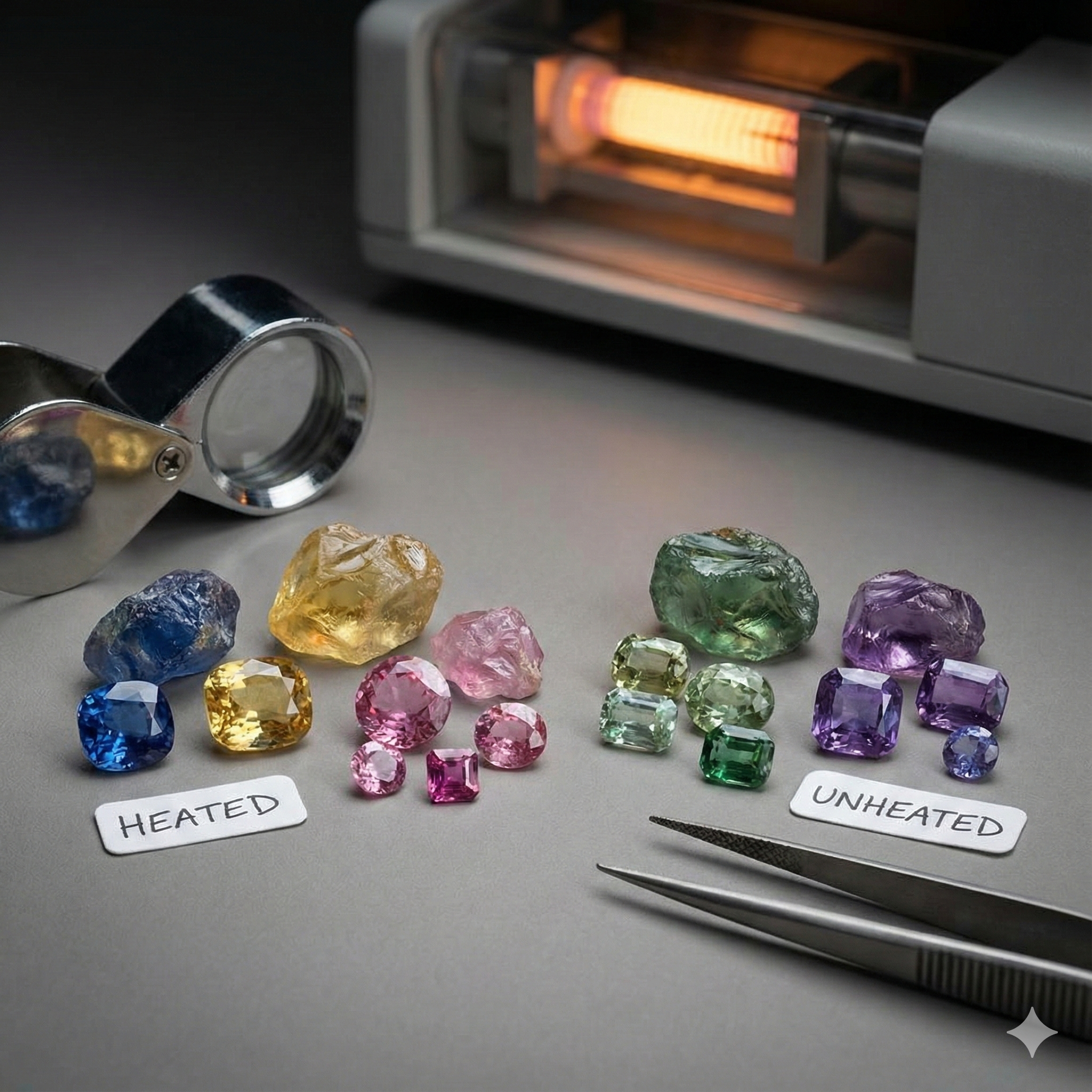
What many clients don’t realize—and what is crucial to explain during an appraisal or sale—is that the vast majority of sapphires on the market are heat-treated.
This isn’t a "fake" process; it is a standard, stable trade practice used for centuries to improve color and clarity. Think of it like a spa day for the gem; controlled heat can dissolve cloudy inclusions and deepen the color to make the stone more marketable.
However, there is a massive price difference between a heated sapphire and a completely natural, unheated one of the same quality. An unheated stone is a rarity of nature, while a heated stone is the industry standard. My job is to determine which one you have, as that dictates the replacement value for your insurance policy.
Inspecting the Stone Since I am not a laboratory gemologist, I don’t rely on advanced chemical analysis. Instead, I use my experience and standard magnification to look for visual clues.
When I look into a sapphire, I am checking clarity characteristics:
Silk: These are tiny needle-like inclusions. In some natural stones, they are actually desirable because they create a velvety softness to the color.
Healed Fractures: Under magnification, heat-treated stones often show specific "fingerprints" or halos around crystals that indicate the stone was exposed to high temperatures.
If a stone looks "too perfect"—like a piece of blue glass—or if the value is potentially very high, I always recommend sending it to a major laboratory (like GIA or AGL) for a definitive report. As an appraiser, knowing when to consult a lab is just as important as knowing what I see through the microscope.
Why It Matters
In the jewelry market, information is everything. A seller might tell you a sapphire is "top quality," but without disclosing treatments, you might overpay significantly.
I once appraised a pendant the owner believed was a rare, untreated museum piece. While it was a genuine sapphire, the visual signs of heat treatment were evident under magnification. It was still a valuable, durable gemstone perfect for daily wear, but it wasn't the investment-grade rarity she thought it was.
Whether you are insuring a family heirloom or looking to buy a new piece, an honest appraisal bridges the gap between what a stone looks like and what it is actually worth. My goal is to ensure you know the full story behind your jewelry—treatments and all.